25 November 2026
Getting the New School Food Standards Rollout Right for Children
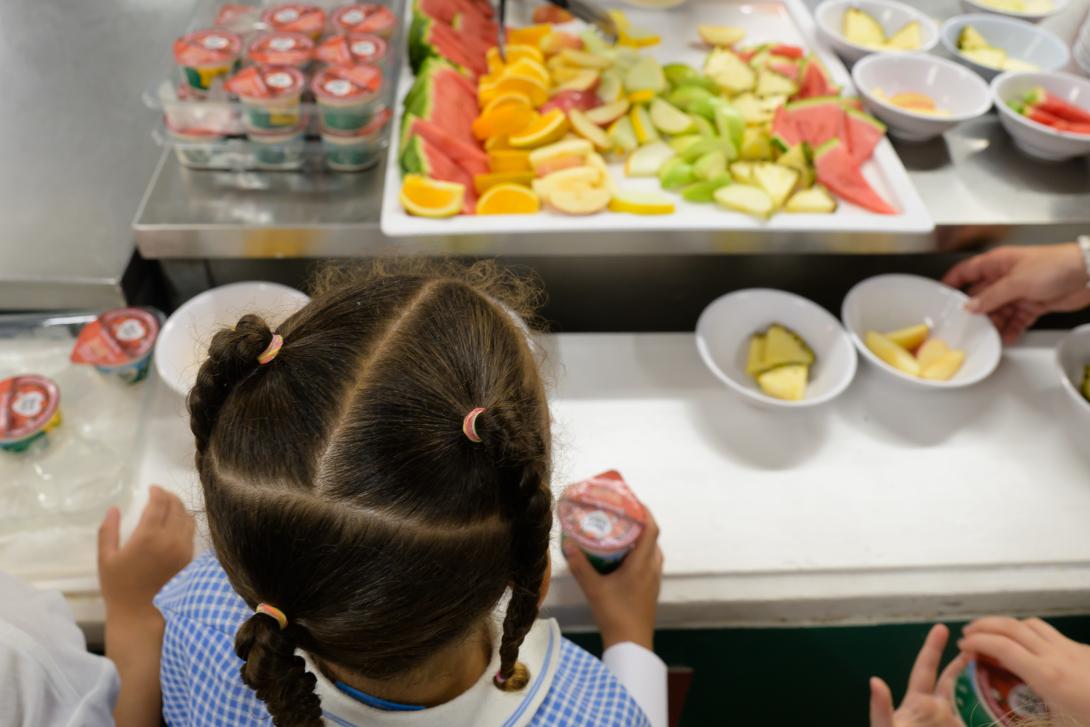
From September 2027, schools in England will be expected to serve food under updated School Food Standards, the first refresh in over a decade. Together with the expansion of Free School Meals to all children in families receiving Universal Credit, the new standards offer an opportunity to make healthier, more nutritious school meals accessible to more children than ever before.
Yet healthier menus only improve children's diets if children eat them. That is why maintaining and increasing school meal uptake should sit at the heart of how the new standards are introduced. Uptake matters both so that children, especially those eligible for Free School Meals, benefit from a nutritious meal rather than a packed lunch or a trip to the high street, as well as for schools and caterers whose budgets depend on the number of meals they serve.
The good news is that the evidence points to healthier food and high uptake going hand in hand when changes are introduced well. The question is not whether better and healthier school food can be popular, but how to make sure schools are equipped to put the new standards into practice successfully. The standards themselves are the first step: clear guidance and practical support for schools and caterers must now be the priority.
Better food is more popular food
Schools across the country are already showing what is possible. Our briefing published earlier this year brings together case studies of schools that have gone further on healthy food than the current standards require, and in every school studied, uptake went up.
At Pokesdown Primary School, free school meal uptake rose from 28% to 90% after the school moved to fresh, seasonal, scratch-cooked food and turned lunchtime into a proper dining experience. Ingol Community Primary School brought its catering in-house, made meals healthier and incorporated pupil feedback, with uptake rising from 57% to 83%. In Richmond, primary schools that moved from reheated frozen meals to food cooked fresh on site saw uptake double from 26% to 52%, while the price per meal fell by 38p.
This makes clear that having quality food that is freshly prepared, pupils involved in shaping menus, a dining experience that children enjoy, and well-supported kitchen teams is a recipe for success. Each school introduced changes carefully, bringing pupils and parents with them.
Learning from the past
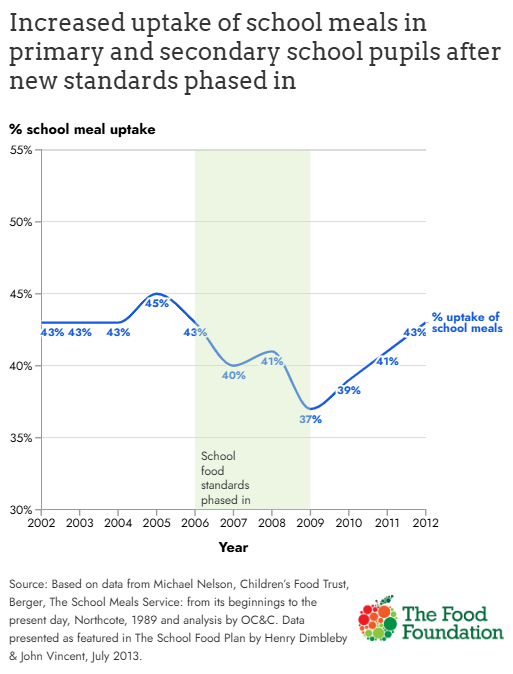
When school food standards were first comprehensively revised and introduced in phases between 2006 and 2009, uptake initially fell (see graph below). However, as schools, caterers, and children adjusted, uptake recovered and kept rising, reaching 47% by 2012 (higher than before the standards were introduced). This resulted in more children eating healthy, nutritious school meals.
Why good implementation makes the difference
Recent evidence reinforces the importance of the way change is introduced. A small-scale feasibility pilot commissioned by the Department of Health and Social Care and the Department for Education tested draft versions of the new standards in eleven schools (eight primary, one middle and three secondary) for six weeks at the end of 2025. While too small to tell us exactly how the standards will work nationally, it offers useful lessons about the conditions for success.
Even where schools only partly implemented the standards, menus became measurably healthier, with less sugar, fat and salt and more fibre, and the report concludes that the standards are both “feasible and acceptable in a range of school settings.” Some of the changes that schools were most cautious about turned out better than expected: fruit was more popular than caterers anticipated, and acceptance of fewer traditional desserts was higher than schools had predicted, with complaints falling over time.
Uptake held steady or increased in six of the eleven schools, particularly where a whole-school approach to food was already in place, and these schools also saw no rise in food waste. Where uptake fell, the report suggests that the short timeframe was insufficient. In the pilot, schools had only weeks to redesign menus and little opportunity to develop alternatives to familiar items. This points to improvements in nutritional quality needing to go hand in hand with food that pupils enjoy, want to eat and can access.
Successful implementation involves more than just changing menus. It includes refining recipes, training kitchen staff, building supply chains and introducing new foods gradually. The government has already responded by adjusting some standards and giving secondary schools an extra year for some of the changes. It’s also important for the government to publish the full updated guidance for schools and caterers as soon as possible to ensure they can make the most of every month of that lead-in time.
Getting the September 2027 rollout right
With the new standards published in September 2026 and due to come in from September 2027, with some requirements for secondary schools phased in from September 2028, there is time to give schools and caterers the lead-in they need while also delivering more nutritious food for pupils. Some of the key ingredients include:
- Supporting catering teams. This includes training, recipes and menu-development help so that compliant food is food children want to eat, with time for staff training and recipe development properly planned in. The School Food Project, a coalition we launched with Bite Back, Chefs in Schools, Jamie Oliver Group and School Food Matters to support school food improvement, is already working to provide this through free training both in schools and online, with online resources free to use on the project hub (add link)
- Making it work for every pupil. Guidance for Secondary schools on developing grab-and-go options that are healthy, quick and appealing are needed, as well as how to ensure the needs of pupils with sensory needs and restricted diets are met.
- Backing a whole-school food approach. Schools that put food at the heart of school life and invest in food education and the involvement of pupils in menu design see the best results.
- Communicating positively. The message to pupils and parents should be about enhancing food and making it better, and what it means for children's development, rather than what has been taken off the menu.
- Getting the funding right. Funding for school food should reflect the real cost of delivering the updated standards so that school catering stays viable everywhere, particularly in smaller and rural schools that can’t benefit from economies of scale. For instance, a small schools subsidy, as proposed by the School Food Review, would help. Clear conditions on free school meal funding would also help make sure it reaches the plate, with schools reporting on how it is spent and on meal uptake.
- Monitoring what matters. Monitoring should look beyond whether schools are technically meeting the standards to understand how they are working in practice. Tracking compliance alongside meal uptake, food waste and pupil experience will help identify where implementation is proving difficult, where additional support is needed and what is working well. A supportive but robust approach to monitoring will be essential to ensuring the standards translate into meaningful improvements for children.
The success of the new standards will ultimately be measured not just by what appears on school menus, but by how many children are choosing to eat it. The evidence shows healthier school food and higher uptake will go hand in hand - provided schools and caterers have the time, resources and support to make the changes work.