22 May 2026
Getting school food funding right: Why September 2026 matters
Getting school food funding right: Why September 2026 matters, by guest blogger Myles Bremner, CEO of Bremner & Co, and co-ordinator of the funding workstream for the School Food Review
We have much to celebrate with the expansion of Free School Meals (FSM) to all children living in families on universal credit. Alongside the updated school food standards, this represents a significant step forward for children’s health and addressing the cost of living.
But successful delivery of both policies will depend on getting the funding right.
From September 2026, existing FSM, universal infant FSM and the London Mayor’s FSM scheme will mean around 4 million children - roughly 40% of pupils in England - will be entitled to free meals. At the same time, the updated school food standards will be introduced.
Recent headlines have highlighted concerns from caterers and schools about the cost of delivering school meals, with rising food, staffing and energy costs putting pressure on already stretched budgets. In this context, changes to the standards may lead to further cost pressures, particularly if funding arrangements does not fully reflect implementation costs.
This blog is part of a wider series on the school food standards. Its central argument is not that more funding is required to deliver high‑quality food or meet the new standards.
Rather, it is that longstanding inefficiency and insufficiency gaps in the school food funding model must be addressed if standards are to be maintained and the expansion of free school meals is to succeed.
The Department for Education will invest over £2 billion a year on school food. Paid for meals adds at least another £1bn to England’s school food system.
If we don't fix school food funding now, and make sure funding works properly for all schools and their caterers in delivering great nutritious food, we risk undermining the success of this important policy.
How free school meal funding works – a fragmented system
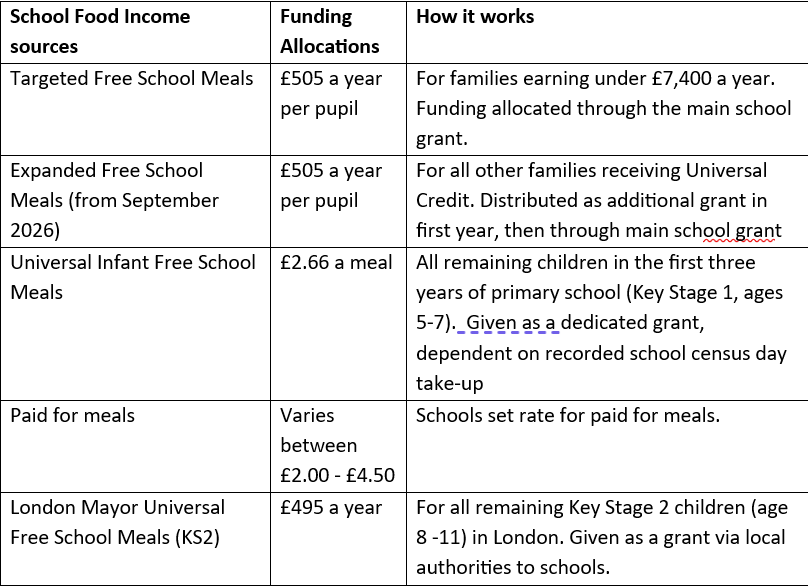
Having different and separate Free School Meal schemes (each with different allocation and distribution methods) means that many schools and caterers find it difficult to answer the simple question: "what is my school food budget?".
School food funding has not kept up with inflation
The core costs of providing a school meal - food ingredients, staffing and utilities - have increased faster than general inflation in recent years.
FSM funding rates have not kept pace with these pressures and have lagged behind the real‑world cost increases faced by schools and caterers.
The Cost of a School Meal report calculated the true cost of a school meal to be £3.16 and it’s widely reported that many schools pay more than £3.00, with the smallest schools upwards of £4.00 a meal. But not all schools.
The importance of economies of scale
The school food funding system ignores a fundamental principle: economies of scale.
School meal provision includes both variable costs, such as ingredients and staffing, and fixed costs, including minimum staffing, kitchen equipment, utilities and food safety compliance.
Larger schools are typically able to spread these fixed costs across a higher volume of meals. In some cases, particularly those with a high take-up and a buoyant mix of paid for and free meals, schools can generate a modest surplus that can be reinvested in food quality or facilities.
Smaller schools face a much starker position. Many fixed costs are largely unchanged regardless of scale, but they are distributed across fewer meals. This results in higher per‑meal costs even when provision is efficient and well managed.
The Cost of a School Meal report noted that financial viability (where economies of scale actually work), kicks in at around 200 to 225 pupils on roll.
This amounts to 10,000 schools likely to face a shortfall between funding and delivery costs.
These smaller schools are digging into other budgets to make school meals work. As Free School Meals expands and more meals are served, the financial exposure of these schools may increase the unwelcome strain on already tight budgets.
What needs to happen
In the long term, we need structural reform.
The School Food Review has recommended a single national funding model combining a fixed annual grant for every school with a per-pupil allocation, which would address economies of scale while keeping the system simple.
The government's announcement that FSM will no longer be used as a proxy for disadvantage funding creates an opportunity to align school food funding reform with a wider school funding review.
But structural reform takes time. September is just four months away and schools need certainty now. Three immediate measures would make a massive difference.
First, introduce a small schools subsidy
The 10,000 schools with 225 pupils or fewer should receive an annual fixed grant of £7,000. (The amount is calculated on funding a school chef for two hours every day, but schools would be free to choose how best to spend their grant).
This additional investment would cost £73.5 million per year - just 3.5% of government’s current school food investment. There are caveats. A blunt 225-pupil cut-off creates a cliff edge and some tapering may well be needed. Schools with higher proportions of FSM pupils face different pressures that a flat grant doesn't fully address. But these are details to refine, not reasons to delay.
Second, introduce FSM conditions of grant
All schools should be required to report (as part of the wider school food accountability mechanism government have committed to) on how funding is used and what provision is delivered. This should cover decision-making on food service, procurement arrangements and uptake of meals.
With government spending £2 billion a year, transparent reporting isn't about distrust – it's about building an evidence base for future reform, further improvements and ensuring best value for money.
Third, communicate clearly about funding allocations
Schools need a single, clear budget summary showing all their free school meal allocations. Presenting representative per‑meal funding rates using realistic assumptions on how many meals pupils actually eat each year could also help schools plan more effectively, even where underlying allocations remain unchanged.
Making success possible
The expansion of FSM and the introduction of updated school food standards reflect a clear policy intent to improve access to nutritious food and support families with the cost of living.
Whether these ambitions succeed in practice will depend on how effectively funding translates into delivery on the ground.
Ensuring that funding arrangements are clear, predictable and aligned with the real costs of provision will support schools in planning and sustaining meal services. For smaller schools, where cost differences are most pronounced, targeted adjustments will ensure the system works consistently.
With the FSM expansion and new standards scheduled to begin in September, now is the time to act.
- This blog is the second in a series as we unpick school food standards. Look out for more on our website and social media channels.