05 August 2026
How the UK's School Food Standards Compare
A Tale of Four Nations: How the UK's School Food Standards Compare
Whether you're in Cardiff, Glasgow, Belfast, Birmingham, or a village, miles from the nearest town, every child should have access to tasty, nutritious school food that offers real choice and respects cultural and dietary needs. The best systems include elements such as standards that reflect the latest dietary guidance, independent monitoring to make sure they're followed, meaningful ways for children and young people to have their voices on school food heard, and free meals for all children who need them.
School food is a devolved matter, so each of the four UK nations sets its own standards and policies. England, Scotland, Wales and Northern Ireland each have their own rules on what schools must serve, who gets a free meal, and how compliance is checked.
Currently, no single UK nation achieves all four features, although some are further ahead than others. Scotland gets closest to the full package, Wales has made big strides on access, and Northern Ireland has strong monitoring but not up-to-date standards to match. England, while historically a laggard on school food standards, is the only nation currently moving on every front at once, overhauling its standards for the first time in a decade, extending free school meals to hundreds of thousands more children, and committing to a national monitoring system. This hands England a genuine opportunity to set the standard for the rest of the UK.
Here's how the four nations compare across three key aspects of school standards.
School food standards across the four nations
As noted above, each nation sets its own school food standards. Rather than compare all four standards line by line, we've focused below on the areas where the gap between what children currently eat and what the dietary evidence recommends is largest: red and processed meat, sugary desserts and confectionery, drinks, and fruit and vegetables.
These are the areas where school food standards have the greatest potential to improve children's health and where the differences between the four nations are most apparent.
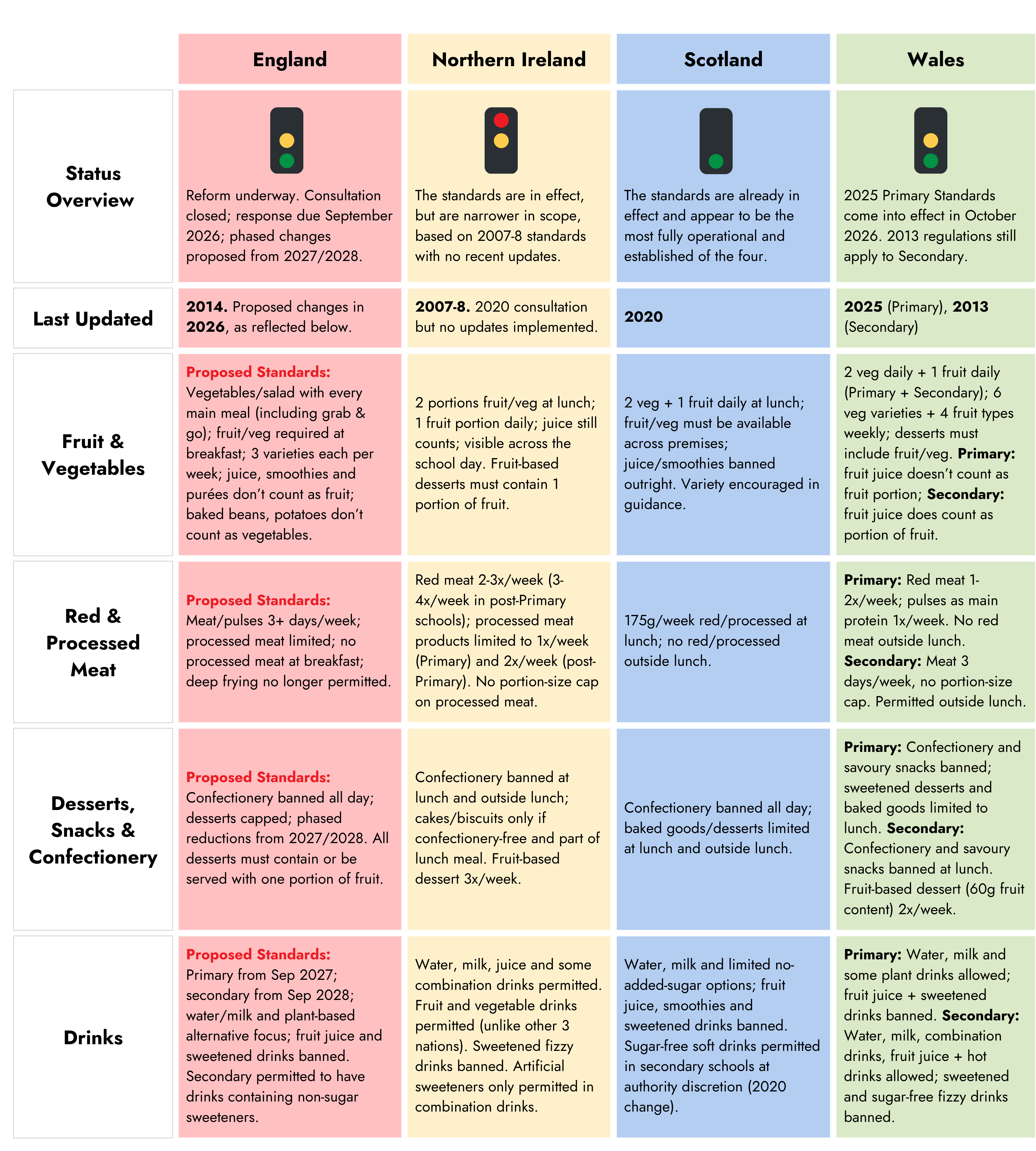
***(full chart can be found here)
Scotland
Scotland's standards are the strongest currently in place. It is the only nation to put a hard weight cap on red and processed meat (175g a week at lunch, and none at all outside lunch) and confectionery is banned across the entire school day, with baked goods and desserts limited both at lunch and beyond it. Two portions of vegetables and one of fruit must be offered at every lunch, and fruit or veg must be available anywhere on the premises that food is served. Drinks are restricted to water, milk and limited no-added-sugar options: fruit juice, smoothies and sweetened drinks are all banned.
Wales
Wales's new primary standards, arriving in October 2026, are very ambitious, but only for primary pupils. Red meat is limited to once or twice a week, fruit juice and sweetened drinks are banned entirely, confectionery and savoury snacks are not permitted, and, in a UK first, a bean- or pulse-based main meal is required every week. Two portions of veg and one of fruit are required daily, and every dessert must contain or come with fruit or veg. However, Wales is running a two-tier system: secondary schools remain on the 2013 regulations, which mandate meat three days a week with no weight cap, permit it outside lunch, and still allow fruit juice. How strong Wales's standards are thus depends entirely on how old the child is.
England
England is playing catch-up, but ambitiously. Its standards haven't been substantially updated since 2014, but the proposed overhaul could vault England towards the front of the pack: confectionery banned all day, desserts capped and served with fruit, deep frying no longer permitted, processed meat limited and removed from breakfast entirely, and fruit juice and sweetened drinks banned, phased in from September 2027 for primary schools and 2028 for secondary schools. Fruit and veg would run through the whole day: fruit and vegetables with every main meal (grab-and-go included), fruit with every dessert, a portion at breakfast, snacks limited largely to fruit and veg, and an end to juice, purées and baked beans counting towards the totals. However, the final strength of the standards depends on what come to fruition in the consultation response due in September 2026.
Northern Ireland
Northern Ireland is standing still. Its standards date back to 2007–08 (older than the pupils they now apply to) and it shows: must be served a minimum of twice a week and a maximum of three times a week in primary, and a minimum of three times a week and a maximum of four times a week in post-primary, there is no weight cap on processed meat, and it permits fruit and vegetable juice drinks, with a glass of juice counting as a child’s fruit portion at lunch. Confectionery is banned, but cakes and biscuits remain part of lunch. The outcome of a review of the current nutritional standards, informed by a public consultation held in 2020, has yet to lead to revised nutritional standards, impacted by the unavailability of additional funding.
Access to free school meals
Good standards mean little if a child can't access the meal in the first place. Across the four nations, some have prioritised universal provision for younger children, while others target support to more low-income families across all school ages. Each approach involves trade-offs between reducing stigma and maximising uptake, or directing limited funding towards children most in need.
Wales has gone furthest on universal provision. Free school lunches are now universal for every primary-age learner, bringing an estimated 175,000 additional children into the system. Secondary provision remains income-based, limited to households on qualifying benefits or Universal Credit.
Scotland combines both approaches. Primary 1 to 5 get universal free school meals regardless of income. A planned extension of universal provision to P6 and P7 was shelved in December 2024; instead, P6 and P7 pupils qualify if their family receives the Scottish Child Payment or Universal Credit with earned income of no more than £995 a month (around £11,940 a year), and secondary pupils qualify via the same Universal Credit threshold.
England is significantly expanding access to free school meals. From September 2026, every child in a Universal Credit household will qualify, extending eligibility to around 500,000 additional children.
Northern Ireland offers no universal provision at any age, but has the UK's most generous income threshold: For the 2026/27 school year, the free school meals income threshold for families who receive Universal Credit increased to £15,900 of annual household earnings (after tax), rising with inflation. A 2024-25 consultation considered universal provision from nursery through to Year 14, but the Education Minister confirmed that budget constraints rule this out for now, opting for the threshold rise instead.
How were children and young people involved?
School food standards are ultimately for children and young people, so they should help shape them. Listening to children isn't just good practice, it's a right enshrined in the UN Convention on the Rights of the Child, recognising that they should have a voice in decisions that affect their daily lives, such as school food.
Wales has gone furthest in formalising pupil voice. Its 2025 consultation ran a dedicated children-and-young-people's version alongside the main document, and of the over 2,700 responses received, a meaningful share came directly from learners.
Scotland commissioned Children’s Parliament to facilitate discussions with children and young people about school food to inform their previous consultation.
England's current consultation has leaned more on stakeholder and parent engagement than dedicated child-led mechanisms. However, through civil society organisations like Bite Back’s youth consultation response portal, and in discussion with the Food Foundation's Young Food Ambassadors who met Ministers and DfE officials repeatedly to press for updated standards and proper monitoring, young people's views have still reached the heart of the process.
Northern Ireland shows little public evidence of dedicated youth consultation feeding into the stalled 2020 review. However, Northern Ireland’s Food in Schools Policy commits to “pupils will play a vital role in making this policy a success. They should be actively involved in decision making around all food in school.”
However, the involvement of children and young people is needed beyond just the consultation stage. If children's views matter when standards are set, they matter just as much when checking whether those standards are being met. Ongoing engagement should be built into how each nation monitors compliance, so that children's experience of the food on their plates becomes evidence, not an afterthought.
How are the standards monitored?
Standards only matter if they're genuinely being met. Without monitoring, a nutritional standard is just a suggestion, and evidence shows this can lead to compliance slips. But monitoring can't simply be copied from one nation to another. School food is delivered differently in each nation, so a system built around one structure won't map neatly onto another. Thus, what matters is that every nation needs a comprehensive monitoring system tailored to how its school food is actually delivered.
Scotland has the only fully independent system, with Health and Nutrition Inspectors sitting within Education Scotland and joining inspection teams visiting primary, secondary and special schools, supported by a self-evaluation framework.
In Wales, monitoring is based on a self-regulatory approach, supported by local authorities, the Welsh Local Government Association (WLGA) and Estyn. The WLGA operates a voluntary Certificate of Compliance scheme, through which catering services can demonstrate that their menus meet the school food regulations. These certificates can be used as evidence during Estyn's core inspections, which assess whether the governing body ensures that food and drink provided by the school complies with legislation, and whether the school has appropriate arrangements in place to promote healthy eating and drinking.
England does not currently have formalised monitoring in place but plans to introduce a national monitoring and enforcement system from 2027. The details of this have yet to be published but the consultation set out two early proposals: requiring every school to appoint a lead governor with designated responsibility for school food, and requiring schools to publish their food policy and menus on their websites - alongside open questions about what else schools and government should do to assure compliance. The test of England's new system will be whether the wider framework adds what these proposals lack: someone from outside the school gate checking what's actually on children's plates (see the School Food Review’s report laying out our practical recommendations for building a monitoring system that works for schools).
Northern Ireland previously had a well-established monitoring system with dedicated nutritional associates and termly compliance checklists, but responsibility for monitoring later transferred to the Education Authority. Schools now monitor compliance through a self-evaluation process, supported by supervisory checks from Education Authority Catering Managers. A 2016 Public Health Agency evaluation found improvements in compliance with the standards but also highlighted ongoing challenges around monitoring and implementation.
What do young people say about their school food?
We asked Food Foundation Food Ambassadors across the UK what quality school food looks like to them, and what they want to see next.
Jacob, lives in Scotland: "When I was in school, most of the food options were quite unhealthy, with only a salad or fruit and vegetables available as healthier alternatives. I also felt that the portion sizes were a little too small for children who are still growing. Many pupils chose to bring a packed lunch instead... I hope school meals become more nutritious and offer a greater variety of healthy options, including fresh vegetables and balanced meals. It's important that young people have access to food that supports their growth, wellbeing and concentration, while still being enjoyable to eat – something I feel my generation often missed out on."
Yusuf, lives in England: "As a young person in school, I've seen how the quality of school food can shape everything from your health to your ability to learn. Too often, long queues, limited time and unhealthy options leave students choosing between eating quickly or not eating at all, while those with dietary requirements can struggle to find safe and nutritious choices. School food should never be an afterthought. Every child deserves a healthy, balanced meal that is affordable, inclusive and gives them the best chance to learn, thrive and reach their potential."
Steph, lives in England: "The current school food system needs to shift to focus on the well-being of students rather than exploiting them to make money. Right now, some schools over-rely on ultra-processed meals that they know will sell well rather than prioritising whole ingredients that are adequately nutritious. I hope that in the near future school food can become something to look forward too, a healthy and filling meal that can be fully enjoyed without rush."
Mithesh, lives in Northern Ireland: “In my experience...all the meals would just be equally unappetising and unnourishing. I have seen this have a tremendous impact on us: my peers wasting more food and being hungry for the rest of the day. Some of my friends have even resorted to skipping school meals and just eating junk like sweets and biscuits. Hence, the canteen has a very bad reputation in my school. Many of my friends (including me) are jealous of other schools who have more variety and rich meals. For me, personally a school meal is something comforting and rich in variety. It has to have various different elements and nutrients, not just chips.”
Jamie, lives in Wales: "The issues with school meals at the moment are those of quality and especially of price. For most of the people at my college, getting food was a treat and very few relied on it for lunch because of the cost. The amount you get for the price is not enough to fill someone's stomach."
The verdict
Scotland currently offers one of the strongest overall models, combining ambitious standards, meaningful youth engagement, broad free school meal provision and independent inspection.
Wales has particularly ambitious new guidelines coming into force later this year for primary schools, and leads on universal free meal provision, but lacks a robust monitoring scheme and still relies on outdated 2013 standards for secondary schools.
Northern Ireland has the UK's most generous income threshold for free meals, but no universal provision at any age, and its standards haven't been updated since before today's secondary school pupils were born.
England is the only nation currently reforming standards, expanding access and building monitoring all at once. By ensuring the final standards are firmly rooted in the latest dietary evidence and are backed by robust monitoring and enforcement, England has the opportunity to create the most comprehensive school food system in the UK.
But the real story here isn't a league table. It's that every piece of the puzzle already exists somewhere in the UK. Scotland undertakes independent inspection of its school food to enforce compliance. Wales has proven universal primary provision can be delivered at scale. Northern Ireland demonstrates that routine compliance checking can become simply part of how schools operate. And England's ambitious update to the school food standards, increase in free school meals, and development of a monitoring framework have the potential to prove that a nation doesn't have to choose between good standards, broad access and proper oversight.
No nation needs to invent anything new; each needs only to learn from its neighbours. Four different systems could be the UK's greatest assets, as it has four live experiments running side by side with the results freely available to anyone willing to look across a border.
If each nation adopted the best of the other three, every child in the UK - whatever nation, city or village they grow up in - would have what they deserve: tasty, nutritious food, a real say in what's on their plate, and the certainty that someone is checking on their behalf.
That prize is within reach. The question is which nation reaches for it first.
*The information in this blog is based on information that is accessible online, as well as resources sent to us by relevant contacts. Please contact Hannah Abrams (Hannah.Abrams@foodfoundation.org.uk) if you have additional information that you think is relevant to consider.
With thanks to: