18 November 2026
Food Prices Tracker: November 2026
By Project Officer Finlay Hatch
Food prices
According to figures published today by the Office for National Statistics (ONS), food and non-alcoholic beverage inflation has decreased from 1.3% to 0.9% in the 12 months to October 2026, with overall inflation currently at 3.7% (CPIH).
This means that since April 2022, when the Food Foundation began tracking the price of a basic basket of food, food prices have increased by 30.6%.
The Bank of England forecasts that this rate of food inflation will remain roughly steady until the end of the year, remaining under 2%.
The current forecasts are far lower than the predictions made at the outbreak of the USA’s war in Iran. In April, actors from across the food and financial industries such as the Bank of England, IGD and the FDF, forecast that inflation might reach anywhere from 6% to 9% by the end of 2026.
Various factors have come together to mean that the effects of the war and summer droughts have yet to hit food prices in the way forecasters anticipated, although the war is yet to come to an end.
9% increase by the end of the year – what happened?
Lower costs, delayed costs
The increases in the input costs have been both lower and more delayed than was feared at the outset of the war. Fertiliser prices spiked at a much lower level than in the wake of the invasion of Ukraine, and oil prices never hit the extremes of $150-$200 a barrel that some analysts feared.
Nonetheless, input costs did increase. Furthermore, in its report accompanying the recent interest rate hike, the Bank of England has reported that firms learned from the Ukraine conflict and moved to contracts with longer-term fixed prices, meaning the higher input costs are yet to be passed on to citizens.
This theory has been given further credence with the release of a Green Alliance report last week, which found that higher retail prices have not been caused by higher agricultural input costs, which have increased only minimally in 2026.
Costs yet to pass through to citizens
When firms have faced higher costs in 2026, they have been more able than anticipated to absorb those costs themselves and accept lower margins.
The Bank cites sensitive consumer demand and fierce market competition for this willingness to accept lower margins following the price increases seen earlier in the cost of living crisis.
There may be another reason.
Rockets and Feathers, the ECIU report released earlier this year, describes a pattern of retail food prices remaining high even after pressures from higher input costs have abated.
This theory explains the pattern of food price changes since the cost of living crisis. Food prices shot up from the end of 2021 through 2022 and 2023, only to remain high, even after input costs like diesel and fertiliser fell back closer to pre-crisis levels.
This again is supported by last week’s Green Alliance report, which shows retail prices and farmgate prices diverging following the inflationary period of 2022. This divergence between costs and revenues explains the margin available to supermarkets to absorb the higher costs that arrived in 2026.
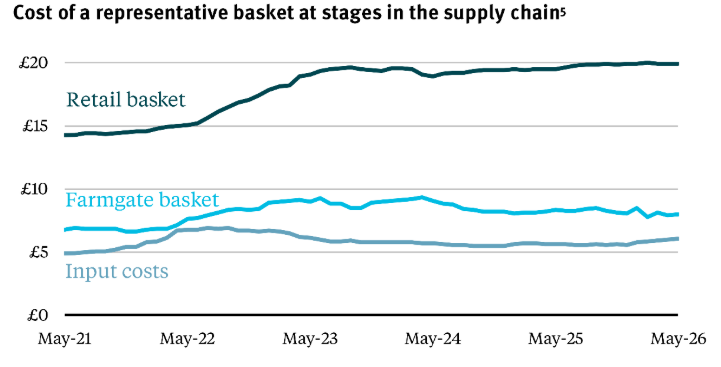
Source: Green Alliance (2026), What’s driving up food prices during England’s agricultural transition?, p.2. Underlying data: Green Alliance analysis of ONS Retail Prices Index and Agricultural Price Index data, commodity prices and IGD production costs.
Food from outside of Europe less affected by summer drought
The impact of the summer drought on food prices has yet to bite because inflationary pressure from the poor yields of European summer crops was balanced out by the prices of other food products either remaining steady or decreasing.
The prices of winter cereals like wheat and barley have been steady as their growth was unaffected by the droughts.
Some foods have even seen prices decrease. For example, beef and cocoa prices, which spiked last year because of poor weather and stronger global demand, have since come back down.
If the price increases are yet to hit, why does it still feel like we have less money to spend on food
Firstly, it’s worth stating the obvious: prices haven’t gone down, they are just rising more slowly than predicted after a period of unprecedented rises.
At the same time, other costs continue to rise – the incoming hike in energy price caps will cause a further squeeze to those already struggling to afford food.
There’s also evidence that food prices play a disproportionately large role in people’s perception of inflation and therefore the overall cost of living. Because of the reflexive nature of inflation (expectations about inflation themselves impact real inflation) the Bank of England believes food deserves particular policy attention.
Are citizens out of the woods?
Unfortunately not.
In its most recent report released this month, the Bank of England itself acknowledges that the higher costs that are yet to be passed on to citizens are very likely to arrive in 2027, but in a different pattern to that assumed in April.
Experts including the Bank and IGD now say that we can expect lower but longer food inflation throughout 2027, instead of the sudden hike in 2026.
According to the Bank, food price inflation could pick up to around 4¾% by mid-2027, largely reflecting this delayed pass-through of higher energy costs along food production and distribution chains that has thus far not hit.
The calm before the storm
We’re now in a more vulnerable position than we were before, with the supply chain having already absorbed much of the pressure from wars waged on Ukraine and Iran, leaving little more room for manoeuvre.
And this increased vulnerability comes as more shocks are already in the pipeline in the form of a record-breaking El Niño and what the UN describes as 'A new age of climate extremes'.
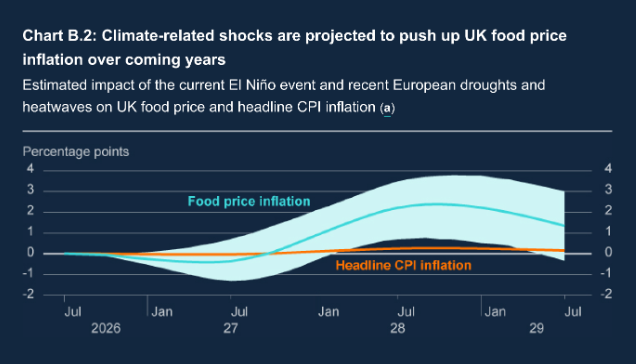
Source: Bank of England (2026), Monetary Policy Report – November 2026, Chart B.2, p.46. Underlying data: NOAA and Bank of England calculations.
Around a quarter of UK food imports, equivalent to around 10% of total food supply, comes from El Niño-exposed regions.
The current El Niño event could begin affecting UK food price inflation from early 2027, initially through prices of fresh products, such as fruit and vegetables, with broader effects then building over several quarters.
The Bank extended the model in Copeland et al (2026) to estimate the combined effects of this summer’s European droughts and heatwaves and the ongoing El Niño event on UK inflation. They found their combined impact could increase UK food price inflation by around two percentage points over 2027 and 2028.
The last few weeks have also seen the realisation of the threat of cyber-attacks to the food system, something that the Food Foundation has consistently flagged.
Large retailers in France and then Belgium 'had to ditch huge amounts of food when their fridges suddenly overheated as a result of anonymous hackers seizing control of their internet-exposed appliance management software' (The Guardian). The episode has highlighted a whole new avenue through which geopolitical events can threaten the security of food supply chains.
Threats to food security don’t exist in isolation
When trying to understand what these various factors means for food prices in the UK, it’s important to consider them in relation to one another, not as isolated events – something also highlighted in the report released this week from the House of Lords and the debate on Climate and Nature Risks in Westminster Hall on Monday.
New research from UK actuaries argues that the UK’s vulnerability to inflation comes from the combination of potential events such as climate change, El Niño, geopolitics and weakening climate policy.
The findings suggest that even if these factors occur in moderation, were they to occur in tandem, their impact on inflation would compound and outpace the impact of just one extreme event in isolation.
What can be done to help people right now?
While risks for further food price shocks are long term and systemic, people need help right now and last month’s Budget failed to give adequate attention to food affordability.
A policy we would like to see is the extension of the Healthy Start scheme to all families receiving Universal Credit. For more info on why the extension of Healthy Start would be such an effective measure, read our Healthy Start briefing, here.
Our national food security risk means this will happen again unless the government acts for the long term
But it’s clear that if we are to avoid ever more extreme price shocks, the government must address the systemic risks to our food system.
That is why we want to see a Good Food Bill that sets out a coherent, long-term plan for our food system. Crucially, the argument for this has landed with the public; 72% of all those polled are supportive.
The Bill would also set the framework to allow the UK to expand its horticulture sector, including beans, which, if successful, could add billions to the economy. For more info on how we want to see the horticulture sector expanded, see our report from earlier this year, here.
Vulnerability to fossil fuel shocks
It’s also vital that the government reduces dependence on fossil fuels throughout the supply chain. While the link between food production costs and volatile international energy prices remains, British citizens will continue to be vulnerable to food price shocks.
Time is of the essence. The government must act to ensure everyone can afford a healthy and sustainable diet now and into the future.
- If you’d like to be kept informed as the situation develops sign up to our newsletter.