17 June 2026
Food Prices Tracker: June 2026
By Project Officer Finlay Hatch
What’s happening to food prices in the UK?
We've been tracking food prices since April 2022 in response to the cost of living crisis. Since then, the price of food has increased by 30.5% according to Office for National Statistics data. The food inflation rate decreased from 3.0% in the 12 months to May 2026 to 2.2% with current overall inflation remaining at 3% (CPIH).
While food inflation has yet to accelerate in the way that we expect it to in the coming months, inflation remains above 2% and ever higher prices continue to make it harder for people to afford the food they need each week.
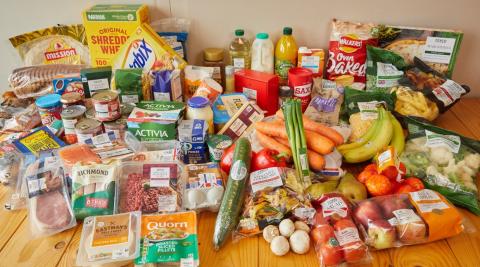
The Food Foundation’s Basic Basket tracking the cost of a weekly shop has seen the cost of the woman’s basket of food now costs £53.51 per week, with the male basket costing £60.24 per week, an increase since April 2022 of 30.6% and 38.4% respectively. To find out more about the Basic Basket, please click here.
Healthy food gets even more expensive
The price rise of the basket only tells part of the story.
Thanks to our most recent Broken Plate report, we know that healthy food remains nearly twice as expensive per calorie as less healthy food, and the gap is widening. When broken down into Eatwell food categories, we find that food and drinks that are high in fat, salt and/or sugar are the only food group to decrease in price from 2024 to 2025.
Protein foods saw the largest annual increase in price at 4.0%, followed by fruit and vegetables at 1.7%. The report also found that shockingly, households with children in the lowest income quintile would need to spend 85% of their disposable income on food to afford the Eatwell Guide, compared to 11% for an average household in the highest income quintile.
To gain further insight into the rising cost of healthy food, we looked at all the fruit and veg in our Basic Basket that we’ve been tracking since 2022, a few months into the cost of living crisis, and compared those retail prices to government data on wholesale prices paid by supermarkets.
[Graph comparing wholesale and retail prices of fruit and vegetables in Food Foundation basic basket]
This measure is calculated as the average price per kilogram across the following fruit and vegetables: Gala apples, Conference pears, carrots, white cabbage, brown onions, salad tomatoes, whole cucumber, red peppers and garden peas. Where price data are unavailable for a period of time, the most recent available price has been carried forward and used for subsequent weeks until new price data become available. This approach ensures a continuous weekly time series despite gaps in the underlying data.
The results are striking. While the red line shows the average price of the fruit and veg in our Basic Basket going up and up since 2022, the average wholesale price indicated with the blue line below has remained relatively stable, with what looks like a seasonal fluctuation.
While this is only a small selection of fruit and veg, it suggests a pattern of retail prices for healthy food increasing, while the prices supermarkets pay to wholesalers has barely changed.
What explains this pattern?
At first glance, although the widening of the gap between wholesale and retail prices could suggest profiteering by supermarkets, there is likely to be a complex set of factors underlying this picture.
The long-term increase in the fruit and veg prices we’ve tracked tells the same story as recent work by Energy and Climate Intelligence Unit (ECIU) in its Rockets and Feathers report. Drawing on 30 years of data, the report finds that when major shocks push food prices up, they tend to come back down slowly and only partially: on average, shelf prices go down just 1% of the original rise after six months, 5% after a year and 7% after two years.
It traces how the gap between underlying costs and shelf prices can widen over the course of a shock: commodity costs tend to rise first, retail prices then catch up and can overshoot them, widening margins. Then as input costs later ease, retail prices often stay elevated, leaving a wider margin than before the shock.
In previous work conducted by the Food Foundation in 2023, we weighed up the evidence on whether supermarkets profited unduly during the early years of the cost of living crisis.
Our briefing found no clear proof of profiteering across grocery retail as a whole: similarly, the Competition and Markets Authority reported that operating margins had in fact fallen, and much of what looked like a reluctance to pass on easing costs could be put down to the lag as lower input prices work through the supply chain. Long, fixed-price contracts, heavy reliance on imports, and higher labour and energy costs all played a part.
The more recent update in 2024, which took a longer five-year view, struck a more pointed note. While profiteering remained unproven for grocery as a whole, it pointed to retailers’ resilient profits, record levels of executive pay and shareholder payouts, the absence of most UK supermarket from the ranks of accredited Real Living Wage employers, and a marked imbalance of power that leaves farmers and shoppers squeezed at either end - something which may amount to a form of market failure.
We noted that retailers’ assurances that reductions in input costs are passed on to cost reductions for shoppers were not borne out by the Food Foundation’s own basket tracking, something that we can see reflected again in this new evidence tracking just fruit and veg.
It’s undoubtedly true that underlying costs for retailers have gone up significantly over the last five years since Covid; increases to national insurance and minimum wage have been introduced, which may explain some of divergence between retail and wholesale prices.
But what the Rockets and Feathers report by ECIU and our own price tracking highlight, is the increasing difficulty citizens face in affording a healthy and sustainable diet for themselves and their families. The unaffordability of food is likely to worsen with the year-on-year impacts of the climate and nature emergency, and rapid food price rises are highly likely by the end of the year due to the knock-on impacts of the war in Iran. What both crises underline is the need for the government to tackle the food related cost of living crisis with long term, systemic policy solutions, like the Good Food Bill.
- If you’d like to be kept informed as the situation develops please sign up to our newsletter.