
03 December 2025
Regulation failing as report shows food industry finds new ways to advertise unhealthy food to young people

Government regulation falling short as new report shows food industry finding new ways to advertise unhealthy food to young people
The Food Foundation’s flagship State of the Nation’s Food Industry report has found that:
- Outdoor advertising spend by food companies increased by 28% between 2021 and 2024 which followed the government’s announcement in July 2020 of a forthcoming ban on TV and online advertising(1)
- McDonald’s is the worst offender and increased outdoor advertising spend by 71% between 2021 and 2024
- Over two thirds (71%) of food marketing cues(2) on the world’s most popular videogame livestreaming platform are for unhealthy (HFSS) food and drinks, with 77% of branded cues for energy drinks and soft drinks, and 20% for the fast food sector(3)
- Approximately 39% of these food and drink cues featured brands rather than identifiable products and would therefore be out of scope of the forthcoming regulations
- Corporate lobbying is rife, with the number of food industry meetings with ministers dwarfing the number of meetings with NGOs, with 10 times as many meetings for industry in the first year of the new Government(4)
The Food Foundation's annual State of the Nation’s Food Industry report reveals that food industry giants are finding loopholes in government regulation intended to protect young people from junk food. Government is being called on to take a stronger stance as evidence of corporate lobbying and delayed policies demonstrates a lack of effective action.
The report comes just weeks after The Lancet published a series of papers showing the rise of Ultra Processed Foods is damaging public health, fuelling chronic diseases worldwide, and deepening health inequalities.
In January 2026 a ban on adverts for food and drink that are high in fat, salt and sugar (HFSS) on TV before 9pm and online will be introduced (the ban was itself delayed due to lobbying).
However, the report shows that since this ban was announced food industry giants have simply shifted to other forms of advertising, undermining efforts to protect young people from their influence.
Outdoor advertising
Outdoor advertising, including billboards, buses, bus shelters, train station advertising, shopping outlets and taxis, is exempt from the ban and the report finds food companies have increased spend on outdoor advertising by 28% between 2021 and 2024 in the years following the government’s announcement in July 2020 of a forthcoming ban on TV advertising.
McDonald’s is by far the largest spender on outdoor advertising, spending a total of £86 million in 2024, an increase of 71% between 2021 and 2024. Unilever, Pepsico, Coca-Cola, Mars and Mondelez also featured in the list of top 20 biggest spenders on outdoor advertising.
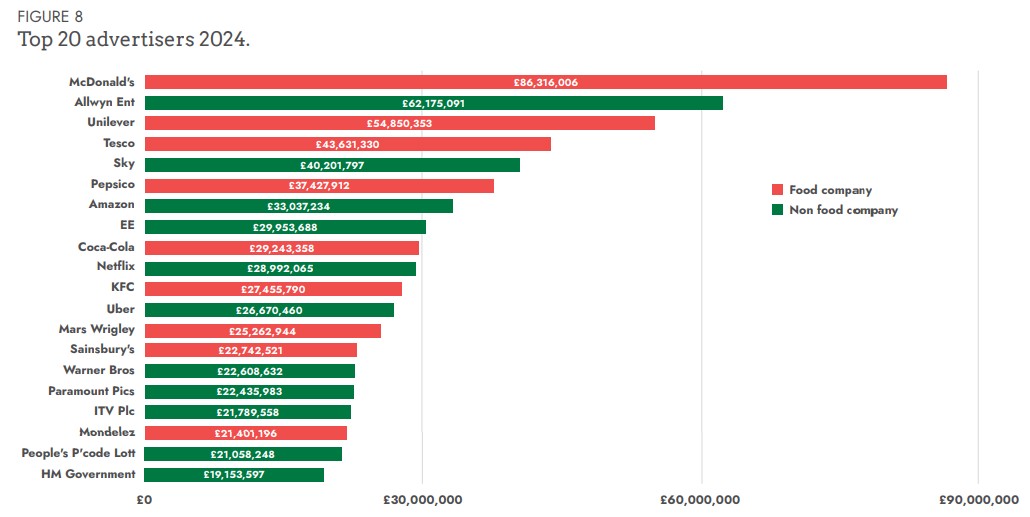
This remains a big issue for children as, excluding digital advertising, outdoor advertising provides the second largest source of their exposure to food advertising (30.3%) after television advertising, and accounts for the largest source of HFSS food advertising (40.0%).
Advertising through videogame and livestreaming platforms
The report warns that young people are also being targeted through videogame livestreaming platforms, where food marketing is subtle and hard to regulate. Gamers’ product mentions and on-screen appearances of products or brands, known as “food cues,” act as advertising that is influential but difficult to monitor.
This is significant given that nearly all UK adolescents (97–100%) have a mobile phone and most (73–79%) use gaming apps or sites.
Food and drink advertising was found to be widespread, with 94% of analysed footage containing a cue. Most cues (71%) promoted unhealthy (HFSS) products, dominated by energy drinks, soft drinks, and fast-food brands.(5)
Four in 10 cues (39%) featured brands rather than specific products, putting them outside forthcoming regulations. Almost all cues (98%) lacked any disclosure of paid promotion, making advertising rules on gaming platforms extremely hard to enforce.
Government must take a stand against corporate influence
The report shows corporate lobbying is widespread: between July 2024 and June 2025, food industry meetings with ministers outnumbered NGO meetings 10 to one, with little transparency about what was discussed. Such power imbalances can stall public-health regulation; the new restrictions on unhealthy food advertising, for instance, took five years to pass and now contain major loopholes.
The Food Foundation urges the Government to strengthen these regulations, introduce a comprehensive Food Bill promoting healthy, sustainable diets, and quickly implement mandatory reporting of healthy food sales for all large food businesses to ensure transparency and support a level playing field.
Rebecca Tobi, Head of Food Business Transformation at The Food Foundation, said: "We cannot continue to leave progress on healthy and sustainable sales to the market. It’s simply not working.
"Fixing the system so that it better serves both people and planet needs bold and urgent action from businesses but also, crucially, the government, who are ultimately responsible for setting the parameters within which businesses operate.
"For too long there has been no long-term vision for the UK’s food system with a striking lack of commercial incentives for businesses to produce and sell us good food. We hope the government will introduce a new Food Bill to set out a clear direction of travel for the future of the UK’s food system and ensure better health and a liveable planet for the next generation lies at the heart of this."
Katharine Jenner, Executive Director, Obesity Health Alliance, said: "These findings show how quickly companies change their behaviour when regulation is announced - which is exactly what we want when policies are well designed, but a serious problem when there are gaping loopholes.
"Outdoor advertising exploded after the Government signalled restrictions on TV and online, with fast-food giants simply shifting their spend to unregulated spaces.
"Future marketing policies must learn from this. They need to be comprehensive, cover all channels, and close the brand-only loophole that leaves so much advertising out of scope.
"Anything less gives industry a clear route to continue targeting families and undermining children’s health."
Baroness Walmsley, Chair of the 2024 House of Lords Food Diet and Obesity Committee, said: "We need significantly more intervention from the government if we are to tackle obesity and the multiple other health problems caused by food in this country.
"This report shows that businesses continue to relentlessly push low nutrient foods which are loaded with calories, despite the negative impact on the health of the nation.
"This is particularly concerning where we see children and young people being targeted. A Good Food Bill is needed to set the direction for policy going forward so we can shift the food system in the long term, and ensure it does a much better job at supporting us all to eat well."
Food Foundation Young Ambassador and school pupil, Yusuf 16, from London said: "As a young person I see the pressure from every angle.
"On the streets we are surrounded by junk food advertising that has risen sharply in just a few years. Online almost everything we watch is saturated with energy drinks and unhealthy snacks.
"It should not be normal for a system to push unhealthy choices on young people. We need leadership that puts health at the centre of the food industry."
Jomi, Young Activist, Bite Back, said: "I'm really happy to see this report because it shows the challenges that young people like me are faced with every day.
"It echoes what we've seen in Bite Back's own research too, which is that most outdoor advertising for food and drink promotes unhealthy products.
"And it's really unfair - over a third of schools have at least one junk food advert within a short walk, and children living in underserved communities are being especially targeted by junk food ads.
"Young people's health is at risk and we're sick of it. We want to see a world where junk food ads no longer surround us."
(1) For this metric we looked at data published by Outsmart, the UK’s trade body for the outdoor (OOH) advertising industry. This data details the biggest spenders within outdoor advertising, broken down by the type of advertising environment (roadside, transport, and retail & leisure), industry category, and ranks spend by individual organisations annually over the period 2021 to 2024.
(2) Food marketing on videogame livestreaming platforms is insidious and can take multiple different forms. References by gamers to products as well as visual displays of brands are known as ‘food cues’ and can appear in the video stream as a physical item (i.e. shown by the gamer in the livestream itself), as an image overlaid on the streamed content, in the title of the stream, or in the streamer’s ‘about’ section (see our technical report for further details).
(3) and (5) Researchers at the University of Liverpool analysed visual food cues displayed during 52 hours of livestreamed gaming videos for Fortnite, uploaded by three popular gaming influencers on Twitch during October 2020– September 2021. Food cues were then categorised according to the WHO Nutrient Profiling Model (NPM). While the study is small, the sample size meets WHO guidelines and provides a useful snapshot of food marketing prevalence on gaming platforms.
(4) This year’s research built on the findings from previous research into ministerial meetings. We looked at the first 12 months of the new term of government (Q3–4 2024 and Q1–2 2025); potentially a window of opportunity for influencing, given that this is often a time when new policies are developed. We compared it to 12 months (Q1–4) in 2023 to track any changes over time and between governments. 2023 was selected as a comparator year given that preceding years are skewed by Brexit and Covid-19, and 2024 was the final year of the last government’s term, with the general election happening mid-way through 2024. We conducted research and analysis of ministerial meetings with the UK food industry and their major trade associations2 as documented on the ‘Transparency and freedom of information releases’ register on the UK government website. All lobbying activity across these departments was analysed by assessing ‘gifts, hospitality, travel and meetings’ documented between July 2024 and June 2025 for eight government departments.
NOTES TO EDITOR
Please contact: Juliet Grant, Senior Communications Manager, The Food Foundation, on 07929 075489 or email juliet.grant@foodfoundation.org.uk
AVAILABLE FOR INTERVIEW
Rebecca Tobi, Head of Food Business Transformation, The Food Foundation
SOCIAL MEDIA
Twitter: @Food_Foundation
Instagram: food.foundation
About The Food Foundation
The Food Foundation is a charity working to influence food policy and business practice, shaping a sustainable food system which makes healthy diets affordable and accessible for all. We work in partnership with researchers, campaigners, community bodies, industry, investors, government and citizens to galvanise the UK’s diverse agents of change, using surprising and inventive ideas to drive fundamental shifts in our food system. These efforts are based on the continual re-evaluation of opportunities for action, building and synthesising strong evidence, convening powerful coalitions, harnessing citizens’ voices and delivering impactful communications.
Registered Charity Number 1187611.


