19 December 2025
Food Prices Tracker: December 2025
By Katina-Leigh Taylor
Consumer Prices Index data (CPIH)
Latest data from the Office of National Statistics finds that food inflation this month has decreased to 3.5% (CPIH). Inflation of food and non-alcoholic beverages has also decreased slightly from 4.9% to 4.2%%, since last month.
Throughout 2025, inflation has continued to remain firmly above the Bank of England’s 2% target, especially in core categories such as food, and been rising again since a plateau in late 2024. The Office for Budget Responsibility’s most recent outlook suggests that UK inflation will gradually moderate in 2026, with forecasts pointing to inflation averaging 2.5% next year and potentially returning closer to the target by 2027.
Basic Basket
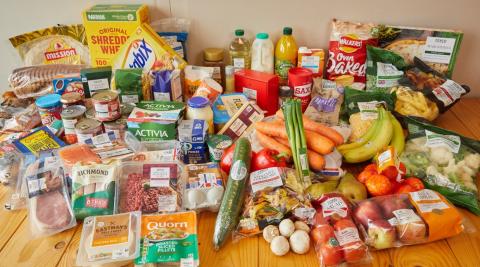
These inflationary changes are continuing to impact on people’s ability to afford the food they need each week. The Food Foundation’s Basic Basket is a shopping basket tracker which measures weekly price changes in what the average man and woman could typically eat as part of a reasonably costed, adequately nutritious diet (see FAQs for further details).
We've been tracking the cost of the Basic Basket since April 2022. Since then, the woman’s basket of food has increased in price by 27.7%, now costing £52.33 per week. The male basket has increased by 33.1% and currently costs £57.98 per week. This illustrates that with higher levels of inflation, food prices have remained much higher than before the cost of living crisis.
How does UK Food Inflation compare to Europe?
Over the three-month period from August to October 2025, UK food inflation ran approximately two percentage points higher than the Euro Area average. More broadly, UK inflation has consistently remained above levels in Europe over the last six months, meaning households are facing not only higher food prices but also higher costs in other areas of spending, from energy bills to administered prices such as water and transport. This combination places additional pressure on household budgets, making the experience of inflation more acute.
It is important to note that the UK’s higher measured inflation is not solely the result of faster price rises, but also affected by the way inflation is measured, as highlighted by Cetex and the Economics Observatory. For example, there is variation across countries in which goods are included and how much weight they carry.
In the UK, items that have seen sharp global price rises carry greater weight in the food basket than in Europe. For example, chocolate and confectionery account for nearly six percent of the UK food basket, compared with just 2.3 percent in the Europe, meaning these high-inflation items have a larger impact on the UK’s measured food inflation.
Drivers of the UK’s Higher Food Inflation
The higher level of inflation seen in the UK is not solely due to differences in ways of measuring. Climate-driven commodity shocks, such as extreme weather affecting cocoa, sugar, and other agricultural commodities, have also fed through into prices. Because the UK relies heavily on imported food and these high inflation items carry greater weight in the UK shopping basket than in many European countries, these global shocks have pushed up UK food inflation more sharply than elsewhere.
Structural factors, including the UK’s reliance on imported fruit, vegetables, and other staples, amplify these pressures. Since Brexit, trade conflicts, certification requirements, and higher regulatory costs have added to import expenses, pushing up the cost of everyday foods.
Another driver that can amplify UK food price inflation is the weaker and more volatile pound. Because the UK imports a large share of its food and fertiliser inputs, a weaker currency means imported goods cost more in sterling terms, and these higher costs tend to be passed through to retail prices - an effect that has been stronger in the UK than in some other economies whose currencies were more stable over the same period, as highlighted by the Institute for Fiscal Measures.
Deloitte further notes that domestic labour costs, including higher National Living Wage increases and employer NICs, have contributed to businesses passing costs on to consumers. From April 2025, domestic labour costs rose sharply. The National Living Wage increased by around 7%, while changes to employer National Insurance contributions raised payroll costs further by increasing the rate and lowering the threshold at which employers start paying NICs.
These changes were widely reported this year as putting particular pressure on food retail, hospitality and care sectors, where labour costs make up a large share of total costs.
What This Means for Households
Taken together, the UK-EU gap in food inflation reflects differences in what households buy, exposure to global price shocks, and the UK’s reliance on imported food. While some of this difference is statistical, the impact is real: higher prices across food and other essentials continue to squeeze household budgets. Even moderate structural differences in inflation rates have meaningful effects on the cost of living, particularly for households who are already struggling.
When food budgets are stretched across both higher food and non-food prices, families are heavily impacted, influencing what they can afford and affecting their dietary choices and overall nutrition. In this context, understanding the drivers behind the UK’s higher measured food inflation is essential to understanding the pressures many households continue to experience.